Tuesday, September 02, 2008

CB Radios and Facebook

The sudden upsurge in the use of Facebook has reminded me of this post that I wrote in June 2006.  I compared blogs to CB radios in this post, but now I am thinking that Facebook is the more apt comparison.    

Ten years from now, will we look back at Facebook and be as embarrassed as we were by the CB radio craze?  Will everyone wonder "What mass hysteria caused so many of us to provide so much information to so many people?"  

Or will we look back on the founding of Facebook as the beginning of a whole new networked consciousness where friends (and other permitted contacts) can practically read each others' thoughts?

The jury is still out on this question.  I bet the persistence of Facebook will depend on whether they can work out a business model that intermediates transactions of some sort.  I don't think the transactions will be the buying and selling of goods (the Facebook Marketplace has not taken off) or advertising (ditto).  I wonder if the transactions will be knowledge or information-based.  

REPOSTED FROM JUNE 14, 2006:

We probably all have friends who tell us more about their personal lives than we really care to know. And at some point most of us have revealed something personal that we later wish we hadn't.

CB Radio - 1970s

When I was a kid in the late '60s and early '70s, CB radio became a huge fad in rural Kentucky where I lived. Everyone had a CB radio in their car, and some had one in their homes. It was a great novelty to be able to talk - actually broadcast - on the CB radio. While some important information about traffic conditions, speed traps, and accidents was broadcast, much of the content was trivial or even embarrassing.

This was exacerbated by the fact that people often considered their transmissions anonymous, even though they had so-called "handles" and were often identifiable. Others did not think about what they were saying at all in the rush to simply have their voices heard on the air.

So when blogging began to catch on, I wondered whether it was just CB radio all over again - except this time in print and available to everyone in the world with a computer connection - not just everyone with a CB radio in a 5-mile radius. CB radios also provided some deniability - if you said something stupid or embarrassing, you could always deny it later, since no one recorded these transmissions.

By contrast, blogs are forever.

The blogging trend coincided with - is there any causation in either direction? - a new wave of confessionals in other media. One of the most notable is the Modern Love column in the NY Times. This column provides a forum for people to write candidly about the ups and downs of their lives, especially their relationships. What is striking about the column is the quality of the writing and the relatively prominent authors who are willing to put themselves out there.

I knew that this genre had hit the mainstream when Debora Spar, a professor at thDebora Spare Harvard Business School, wrote a column about childbearing and adoption. Very well written - and very personal and revealing. Although I don't know her personally, I have taken some classes from her, and she did not strike me as one of those people who are constantly providing "TMI" (too much information). But the column was quite moving, and she was doing a service by writing it.

Hmmm... It will still take me a while to loosen up.

Tuesday, August 19, 2008

Knowledge and the $64,000 question

The traditional philanthropic model revolves around money...Money is important, but it's not everything... When I talk to friends and colleagues in the nonprofit sector, what I hear again and again is a desire for knowledge.

There are a lot of reasons why nonprofit executives are hungry for knowledge. They work on particularly stubborn problems...This knowledge transfer is already happening, but not effectively. Face-to-face conferences are expensive and often logistically impossible...like all personal networks, they don't scale efficiently...

That is from a nice post by Michael Idinopulos over at SocialText. I really like how he highlights the importance of knowledge as an equal partner of money in the equation. He goes on to say:
The absence of a strong market mechanism and regulating institutions allow bad management practices to endure.
The interesting thing about markets is that they involve transactions - someone provides something to someone else for something in return. It doesn't have to be money - it can be status, a favor, or just a good feeling. But without this "something in return," markets don't function well.

Michael goes on to say:

It's not hard to imagine a better way. I'm envisioning an online knowledge networking tool for nonprofits...

How can we make such an online knowledge tool into a well-functioning market so that it gets widely used? That is the $64,000 question.


Wednesday, August 13, 2008

Slow Coffee

The Slow Food Movement is gaining momentum, and I have greatly enjoyed the revival of farmers markets around the Washington, DC area.

I ran into a guy a while back who represents the best of what you might call the "Slow Drink" movement. He has started a small business roasting his own coffee in Charles Town, WV. Largely self-taught, he is producing what I have found to be some of the best coffee in the world.

Check him out at The Black Dog Coffee Company.

Pandora on IPhone

I am testing the Kool-Aid by trying a new iPhone. The jury is out on some of the features and functionality, but there is one application that is fabulous: Pandora.

If you have not tried Pandora, which allows you to create your own custom radio stations on the web, you should. You can download the iPhone app here.

Pandora is a great company, run by great folks. And best of all, Pandora and GlobalGiving have teamed up to connect Pandora's huge audience of music lovers with GlobalGiving projects that use music to improve the lives of people around the world.

Tuesday, August 12, 2008

Innovators Dilemma

In 1995 Clayton Christensen coined the terms “disruptive technology” and “disruptive innovations” to describe technological innovations, products or services that use a “disruptive” strategy rather than “revolutionary” or “sustaining” strategies to overturn dominant or status quo products in a market.

“Disruptive innovations” can occasionally come to dominate an existing market, either by filling a role that the older technologies couldn’t — as cheaper, smaller sized flash memory is doing in the personal data storage area. Or by successfully moving up-market through performance improvements until finally displacing the market leaders and incumbents — as digital photography replaced film photography as the front-runner.

At the heart of the Innovator’s Dilemma for the larger, older, most historically successful nonprofits is the bind of general or unrestricted funds philosophy and the need to find ways to ‘earmark’ and connect donors and recipients in a better way. It’s less about one OR the other, and more about borrowing ideas from each, and mutually benefiting from the unique selling points of the third party fundraisers and embedding them in the all-too-staid conventional groups.
That is from a very good post by Roger Craver, over at The Agitator.

Thursday, July 31, 2008

Filmanthropy

Check out Snag Films, a new site from Ted Leonsis.  Snag Film's own blurb describes it well:


At SnagFilms.com, you can watch full-length documentary films for free, but we also make it easy for you to take our films with you and put them anywhere on the web. When you embed a widget on your web site, you open a virtual movie theater and become a “Filmanthropist.” Donate your pixels and support independent film! And click on “info” on any widget to learn more about that film and a related charity you can also support.


Donations to the related charities are processed by us at GlobalGiving.  Walt Mossberg did a nice piece about Snag Films in the Wall Street Journal.


Tuesday, July 29, 2008

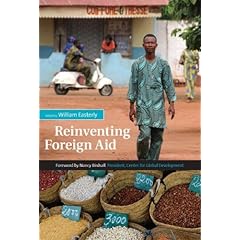
Reinventing Aid


I am happy to announce that Reinventing Aid has been published by MIT Press.  Edited by Bill Easterly, it is a collection of essays (including one by Mari and me) that point the way toward a new approach to foreign aid.  

The introduction by Bill is by itself worth the price of the book.  I will use it the next time I teach a class on international development.  

Many of the individual chapters are also outstanding and are highly recommended for more advanced readers.  (Send me an email for recommendations.)


Friday, July 25, 2008

A New Shade of Cool


Today we launched GlobalGiving Green - a new part of the site that highlights projects that BOTH fight global warming AND improve local economic, social, or environmental conditions.

Stephanie Strom did a very nice piece about it in today's New York Times.

It's only a first step, but an exciting one that could potentially have far reaching effects, as you can read in the Times article. Mari is in the process of writing a longer piece about why it is critical to help get developing countries on a sustainble carbon path.

Two big shout outs on this one - first to the Packard Foundation, which encouraged and helped fund this. And second to Joan Ochi, Stephanie Fischer, Georg Apitz, and other colleagues here at GlobalGiving who worked so hard to create this.


Tuesday, July 08, 2008

Sweet Sixteen

My grandmother ("Mood") turned 99 this past week, and Mari and I went to visit her at the nursing home in Manchester, NH.  For several years, Mood has suffered from dementia, and she doesn't recognize her family members.  

We've gotten used to it, though at the beginning it was wrenching.  As with many elderly people, she has stronger recall from the distant past, and until last year she was able to remember stories and songs from her youth in the 1910s and 1920s.  She would also respond to questions in Finnish, her parents' native tongue. But for the most part, she had a distant look in her eyes when we visited her.

Early this year, Mood took a sharp turn for the worse, and stopped eating or responding to any verbal interactions.  She lost a lot of weight and became extremely gaunt.  On our previous visit a couple of months ago, I was shocked to see her wasting away in bed. The nursing home staff told my mom that the end was near, and we decided to commence hospice care.  

Over the next couple of months, the caring hospice people came several times a week to spend time with Mood - talking to her and stroking her arm - notwithstanding her lack of apparent response.  My mom called to say that Mood was improving, and even sitting up in a chair.

Mari and I sat opposite Mood on our visit last week, and I searched in vain for a connection with her.  Nothing worked.  I could remember only one word of Finnish.  So finally I just decided to ask her:  "Mood, do you know how old you are?"  No response.  My mom told me that I would have to shout, since her hearing was bad.  

"MOOD, DO YOU KNOW HOW OLD YOU ARE?" I practically yelled.

Mood cocked her head suddenly, and her eyes cleared.  

"Sixteen," she responded impishly, with a slight smile.

Then she was gone again.  So we sat there some more, and I rubbed her arm, and my sister called from Seattle and sang some songs to her, and Mood's head nodded slightly with the beat as she stared into the distance.

--

In honor of Mood's birthday, my mother and uncle made a donation through GlobalGiving to Help Feed 200 Neglected Elderly in Guatemala.  I was happy to see that they joined 58 other donors who together have provided enough money to feed over fifty women for a year.

Tuesday, July 01, 2008

Mari does CNN...